Nudges Work—But the Average Is d = 0.43: What 200 Studies Really Show
A meta-analysis benchmark for setting realistic expectations on choice-architecture interventions
“Nudges work” has become one of the most repeated phrases in behavioral marketing. Far fewer people can answer the follow-up: how much do they work?
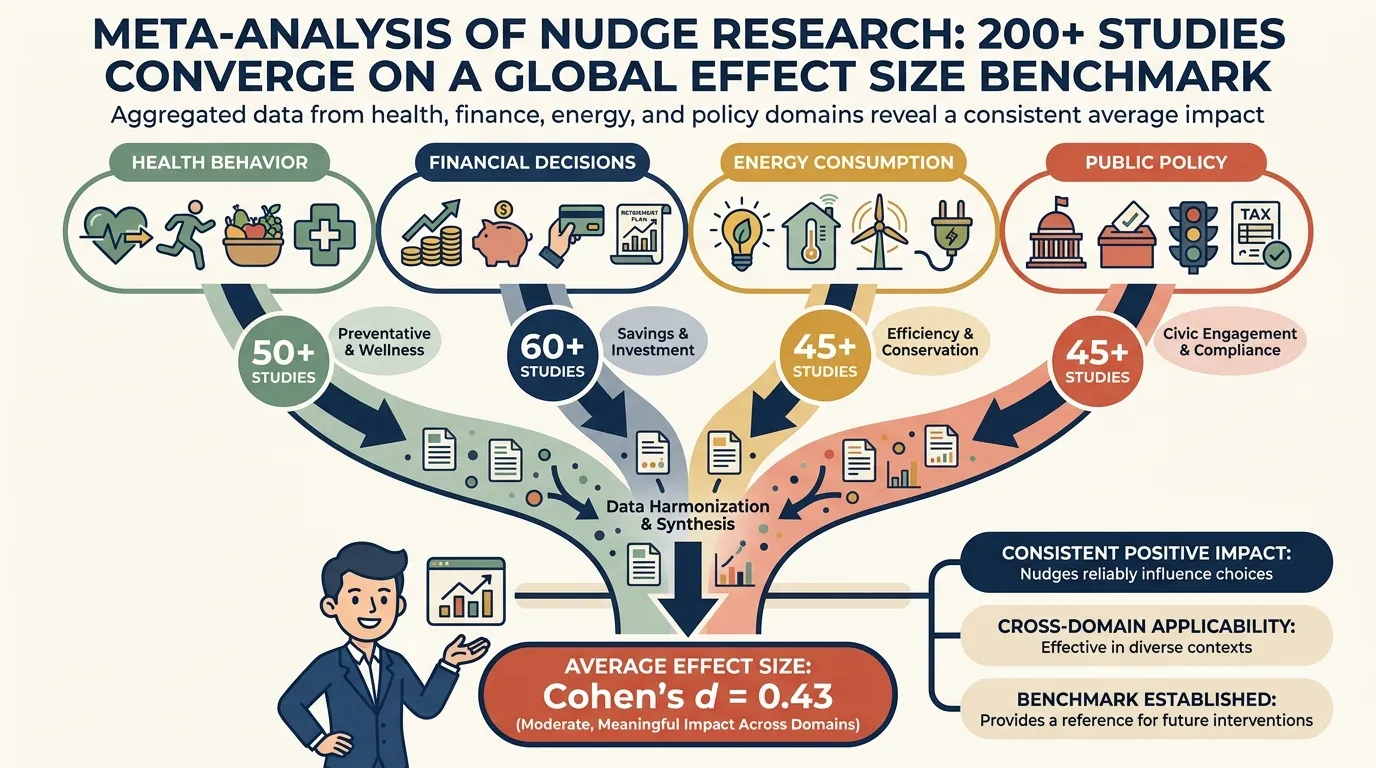
A landmark 2021 meta-analysis published in PNAS by Stephanie Mertens and colleagues finally put a number to it. Synthesizing more than 200 studies and over 440 effect sizes, they estimated the average effect of nudging interventions at Cohen’s d = 0.43.
What d = 0.43 Actually Means
Effect Size is a standardized measure of intervention strength. By Jacob Cohen’s benchmarks, d = 0.2 is “small,” d = 0.5 is “medium,” and d = 0.8 is “large.” Nudging’s average d = 0.43 lands squarely in the small-to-medium range.
This is not “doesn’t work”—it is “not dramatic.” Rather than doubling a conversion rate, a realistic expectation is a consistent 10–15% lift, depending heavily on the specific design and context.
The power of Meta-Analysis is precisely this: it extracts stable patterns invisible in any single study by pooling many. Mertens and colleagues computed this figure across behavioral domains—health, finance, energy, public policy—making the case that d ≈ 0.43 is a general tendency, not a domain-specific fluke.
Which Nudges Work Best
Choice Architecture interventions span a wide range: changing defaults (opt-out organ donation registration), social norm messages (“92% of your neighbors use less energy than you”), and manipulating the number and order of options.
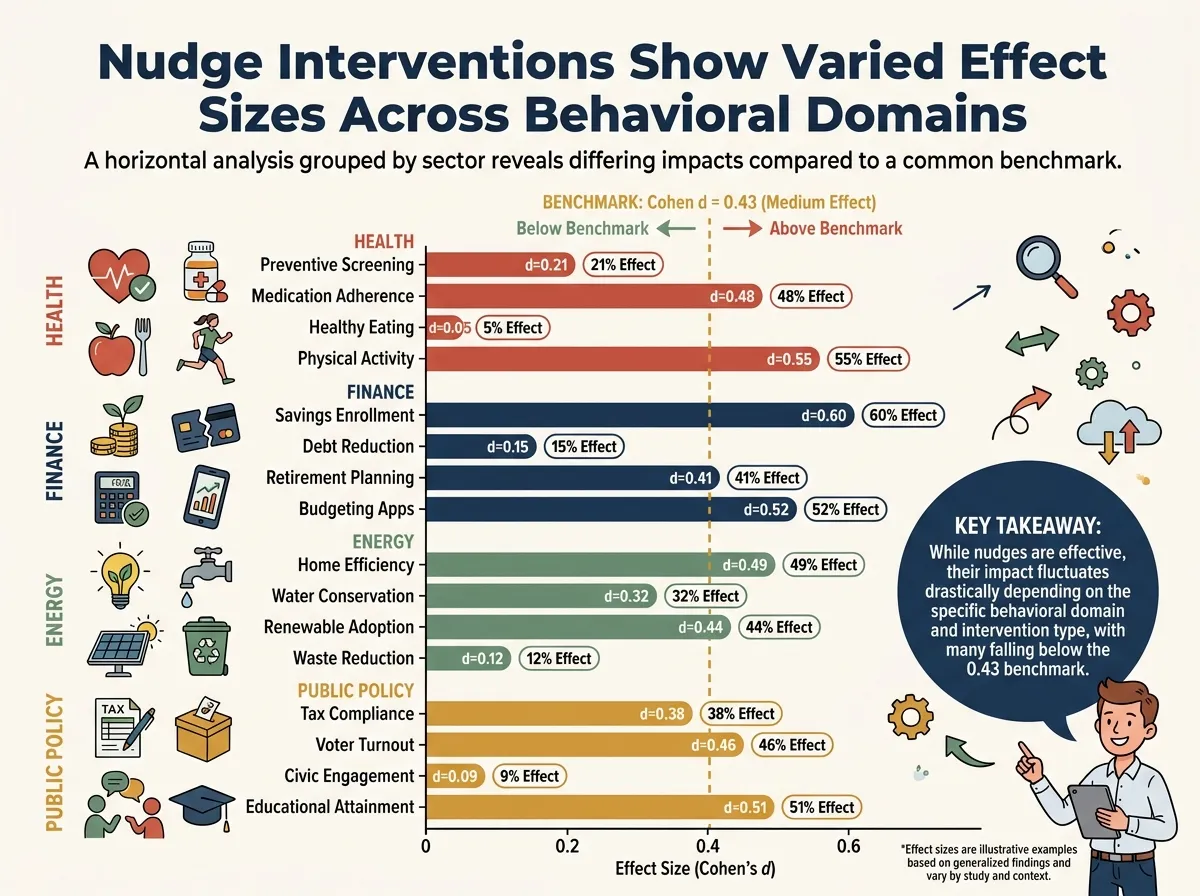
Mertens’ analysis found that default changes tend to be among the highest-impact interventions. Domain differences were also clear: nudges for health behavior showed higher average effects than those targeting financial behavior.
This paper’s core contribution is upgrading “nudges work” from ad hoc anecdote to collective evidence—while being honest about the limits of that evidence.
Crucially, the analysis also reveals high heterogeneity across studies. Even within the same intervention type—say, changing a default—effect sizes vary enormously depending on target population, context, and design quality. “Nudges always work” is not what the evidence says.
Publication Bias and the Reproducibility Problem
The Mertens meta-analysis triggered a significant critical reanalysis. Stefan Maier and colleagues (2022) argued that once publication bias is corrected, the effect size shrinks close to zero.
This is the structural challenge of Meta-Analysis: the studies included are those that got published, and published studies tend to be those with significant positive results. Nudge experiments that found no effect often stay in file drawers. Correcting for this distortion with statistical tools substantially reduces d = 0.43, per Maier et al.
This debate belongs to the same family as the broader “replication crisis” (Open Science Collaboration, 2015). Nudge research sits at an active frontier where empirical standards are still being negotiated.
Two Practical Takeaways for Marketing Implementation
Despite the ongoing debate, the body of evidence yields two clear implications for practitioners.
First, treat d = 0.43 as an expectation ceiling. Any business case for a Choice Architecture intervention that assumes larger-than-meta-analysis effects is probably too optimistic. If your A/B test returns a lift corresponding to d = 0.15–0.25, that is not a failure—it falls comfortably within the distribution of effects documented across hundreds of studies.
Second, design quality determines where on the distribution you land. The high heterogeneity Mertens and colleagues document means “nudge vs. no nudge” is the wrong question. “How well is this nudge designed?” is the right one. A default change that is easy to undo quickly loses its effect. A social norm message that conflicts with the recipient’s self-concept can backfire. Execution details drive the outcome.
Design, Not Label, Is What Differentiates
The word Nudge is convenient—but its convenience has sometimes licensed sloppy design. What Mertens’ meta-analysis actually hands practitioners is not reassurance that nudges reliably work; it is a benchmark that clarifies where design quality determines whether you land above or below average.
Set your expectation at d ≈ 0.43, then invest in the specifics: the stickiness of the default, the precision of the framing, the ordering of options. That is the most actionable reading the collective evidence affords.
Related Articles

Designing Out Purchase Anxiety: The 2026 CRO Psychology Playbook for Full-Funnel Uncertainty Reduction

The Three Consumer Shifts Rewriting Marketing in 2026: Purpose, the Value-Cost Paradox, and the Social Commerce Surge

When Clicks Disappear: Five Marketing Trends Dominating 2026
10 Psychological Pricing Techniques: How Reference Points Shape Purchase Decisions
Seven Axes of Psychological Pricing and the Trust They Quietly Erode