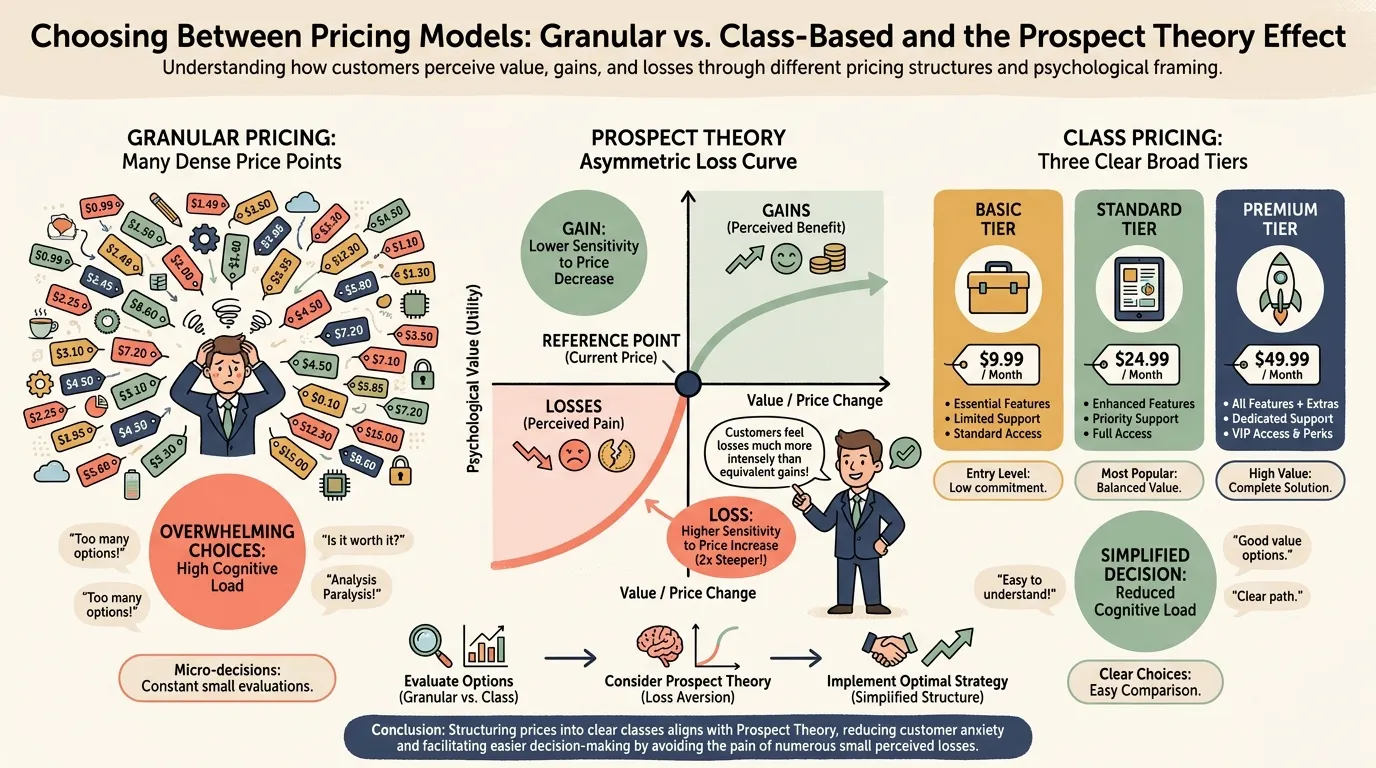
Class Pricing
A pricing strategy that bundles a range of products or customer segments into a small number of discrete price classes. Rather than optimizing each price point individually, class pricing deliberately limits granularity to reduce the number of adjacent-price comparisons consumers make, thereby suppressing loss-aversion responses.
Xiao (UW-Milwaukee, 2026) formalized the concept in “Consumer-Driven Class Pricing,” showing that even when AI enables individual-level optimization, clustering prices into fewer tiers can yield higher aggregate profit by controlling Reference Price formation and the asymmetric impact of Loss Aversion.