10 Psychological Pricing Techniques: How Reference Points Shape Purchase Decisions
The product stays the same — only the framing changes. Two shared principles behind every pricing psychology tactic.
Price is not a number — it is a comparison axis built inside the consumer’s mind. Without changing the product quality or cost structure, businesses can significantly shift purchase decisions simply by changing how the price is presented. Psychological pricing is the discipline of designing that shift.
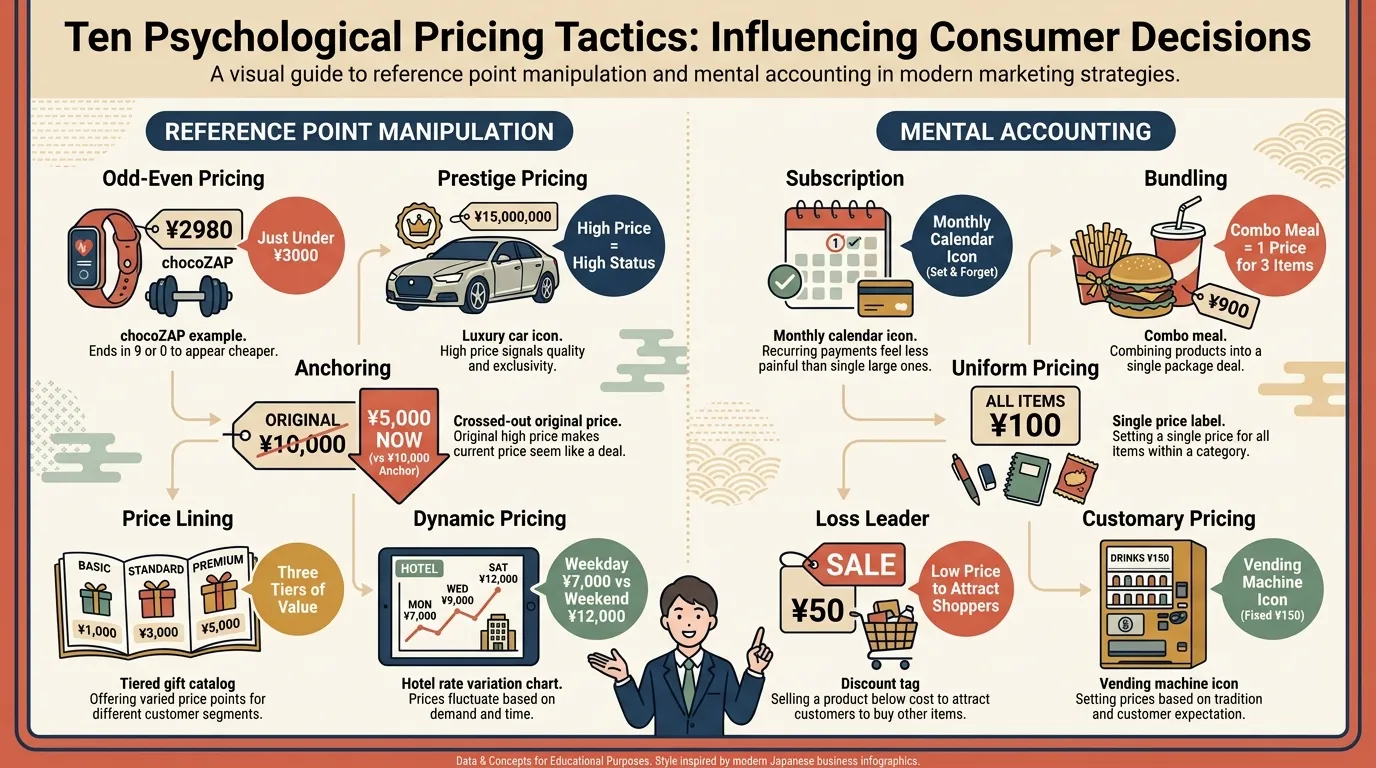
Mapping all ten techniques compiled by Shopify Japan, a clear pattern emerges: beneath their surface differences, two shared principles are at work. The first is reference point manipulation — deliberately moving the baseline the consumer uses to judge “expensive or cheap.” The second is Mental Accounting — exploiting the human tendency to mentally file spending into different psychological “wallets.” When you organize all ten methods through these two lenses, the strategic logic of each becomes much sharper.
The Five Reference-Point Tactics
A “reference point” is the internal benchmark consumers use when evaluating a price. It is not fixed — it shifts based on what was shown first, the surrounding context, and competitor pricing. The designer who can move that reference point controls how the same absolute price is perceived.
Odd-Even Pricing is the most fundamental application. chocoZAP’s monthly fee of ¥2,980 is only ¥20 cheaper than the round number ¥3,000, but the brain files it in the “2,000s” category. Because consumers judge price ranges by leading digits, shaving a small amount off a round number shifts the item into a lower perceived price tier — a disproportionately large gain for a trivial discount.
Prestige Pricing works in the opposite direction. Lexus maintains its price floor in the ¥5 million range precisely because a high price is itself a signal of quality and status. Lowering the reference point triggers suspicion — “if it’s that cheap, something must be wrong.” This is why luxury brands guard against discounting almost as a matter of survival.
Anchoring Effect turns the first number shown into the reference point itself. “Regular price ¥15,000 → Today only ¥9,800” works because the ¥15,000 figure, once seen, lodges in memory as the anchor. The ¥9,800 is then evaluated relative to that anchor, amplifying its perceived discount far beyond the absolute difference. This is Tversky and Kahneman’s reference dependence made commercially actionable.
Price lining builds the reference point into the structure of available choices. When Ringbell’s catalog gifts are arrayed at ¥5,000, ¥10,000, and ¥20,000, consumers automatically extract “around ¥10,000 seems reasonable” as a reference point from the choice set itself. The price architecture does the work of creating the standard.
Dynamic pricing exploits what Hsee calls distinction bias: things feel expensive in direct comparison but not when evaluated alone. Hotel and airline prices are presented as single quotes at the moment of search, making comparison to low-season rates cognitively unavailable. Designing that “no-comparison moment” is the real mechanism behind dynamic pricing — not merely algorithmic efficiency.
The Five Mental-Accounting Tactics
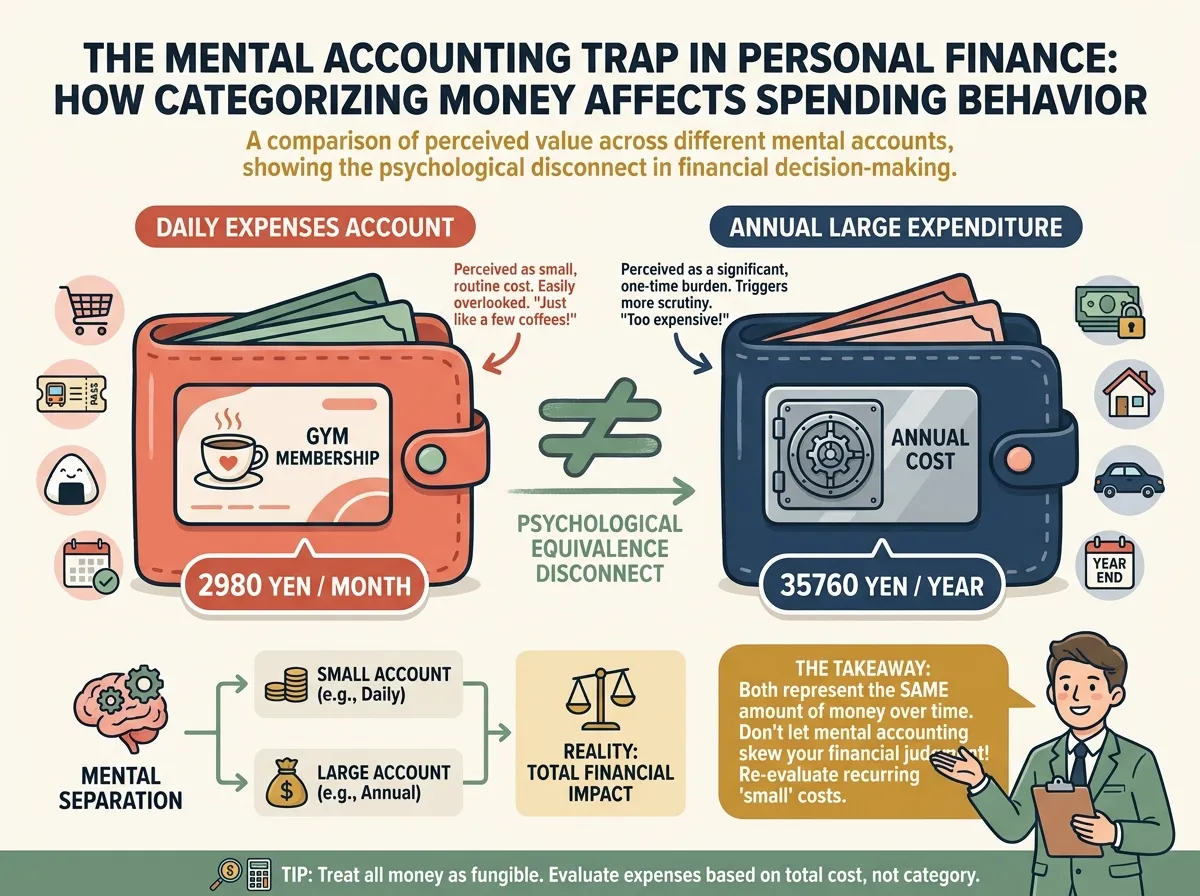
Thaler’s mental accounting describes the human tendency to sort spending into separate psychological accounts — daily expenses, work costs, discretionary luxuries — and to evaluate purchases against the norms of each account. The same ¥12,000 feels very different as “¥1,000/month” versus “¥12,000 upfront,” because these two framings draw from different internal accounts.
chocoZAP’s ¥2,980/month slides into the “daily incidentals” account, sitting comfortably alongside coffee and lunch. The identical cost framed as “¥35,760/year gym membership” is routed to the large-expenditure account — and suddenly requires a different level of commitment to approve.
Subscription pricing is mental accounting’s most powerful form. Monthly framing keeps a service inside everyday spending accounts, reducing both the activation energy to subscribe and the psychological trigger to cancel. Grocery delivery platforms that charge a monthly flat fee operate on this same logic: the cost becomes a fixed-cost utility rather than a per-use variable expense.
Bundling bypasses individual value calculations. McDonald’s combo meals aggregate burger, fries, and drink into a single unit of evaluation. The consumer judges the bundle’s overall value rather than scrutinizing whether each component justifies its portion of the price — creating a separate “set-meal account” that obscures the underlying unit economics.
Uniform pricing eliminates comparison cost entirely. Toriki’s ¥280 flat price across the menu removes the “is this dish expensive?” judgment from each order. Shoppers shift cognitive energy from value comparison to preference selection — a fundamentally different and less friction-laden task.
Loss-leader pricing books a promotional item’s loss in the “customer acquisition” account rather than the product account. A supermarket’s ¥99 milk produces a direct loss but triggers a full shopping trip in which customers buy higher-margin products at standard prices. The economics only make sense when costs are mentally reclassified.
Customary pricing describes a state where long repetition has fixed a “this category costs this much” norm in consumers’ mental accounting. Vending machine prices for canned beverages or gum became so ingrained over decades that sudden increases face disproportionate resistance — what behavioral economists call status quo bias. Maintaining a customary price is, paradoxically, a strategic asset.
When Both Principles Work Together
The most effective pricing designs layer both mechanisms simultaneously. A subscription with dynamic introductory anchoring — “regular ¥1,980/month, first three months ¥480” — manipulates the reference point while routing the ongoing cost into a low-friction daily account. Product bundles with a crossed-out “original price” combine anchoring with evaluation simplification.
The practical starting point is diagnostic: which reference point are consumers currently using to judge your product? And which mental account are they filing it into? The answers determine how you frame price granularity (monthly, annual, per-use), what context signals you place around the price, and which of the ten tactics is most likely to move the needle without eroding long-term trust.
Sources: Psychological Pricing: 10 Strategies and Examples — Shopify Japan, 2026
Related Articles
Seven Axes of Psychological Pricing and the Trust They Quietly Erode
How Anchoring Quietly Shapes SaaS Pricing
When Clicks Disappear: Five Marketing Trends Dominating 2026
Why Japanese Companies Keep Apologizing for Price Increases — and How Value-Based Pricing Fixes It
Why Some Experiences Feel Truly Fun